
📌 Should You Trust ESG Ratings — or ESG Data?

Updated: Jun 22
A recent regulatory shake-up raises a vital question: do we still trust ESG rating agencies — or should we put our faith in the underlying ESG data instead? The answer is becoming clearer: the data is what matters.
48% of ESG rating users report serious concerns about the transparency of methodologies and data sources (Source: FCA Market Study, 2023). That’s nearly half the market questioning the very foundation of these ratings. Yet, ESG ratings aren’t useless—they serve a purpose. The issue is their lack of consistency and reliability, which is now under the regulatory microscope.
🔍 What the New Regulation on ESG Ratings Highlights
The reforms focus on four pillars: transparency, governance, data & methodology quality, and conflict-of-interest management.
Providers will be required to publicly disclose how their ratings are constructed: what ESG factors they assess, whether they report absolute or peer-relative scores, how they define coverage, and what data sources they use.
They must implement robust data-quality controls, clear methodology application, consistent governance, and audit trails for how ratings are generated.
Conflicts of interest, for instance, when the same firm rates a company and also advises it, must be identified, managed, and disclosed.
Rated entities will get the right to see the data that underlies their rating — and to correct factual errors. Transparency isn’t optional anymore.
The regulatory proposals — now open for consultation — are expected to be finalized by the end of 2026, with enforcement starting in mid-2028.
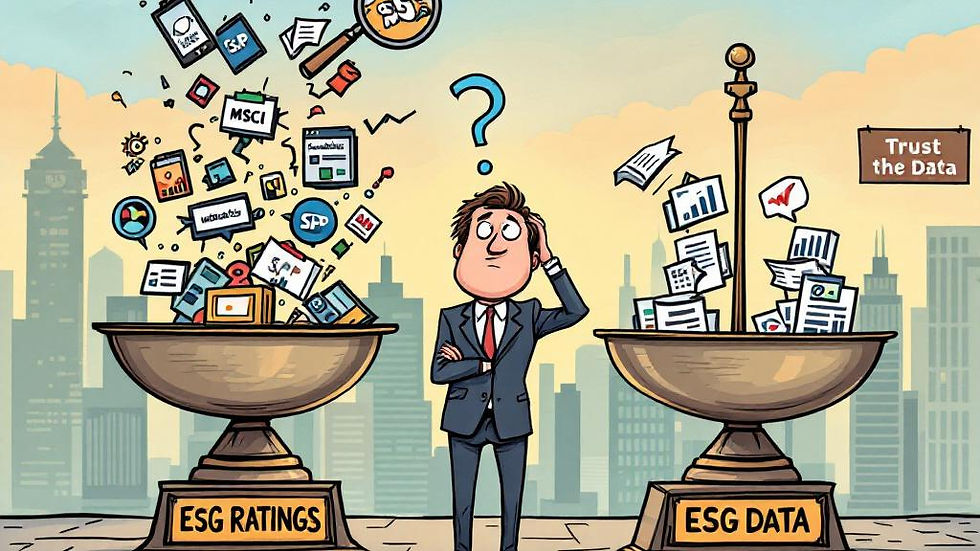
⚠️ Why This Matters: Limitations of ESG Ratings vs Data
A growing body of evidence shows ESG ratings are far less consistent than other business ratings. For example, a widely cited academic benchmark (MIT) found correlation between different ESG rating agencies averages around 0.3 to 0.61 — whereas for credit-rating agencies that figure is around 0.99. This gap illustrates a fundamental problem: two different ESG rating agencies can come to very different conclusions about the same company.
In a 2024 analysis by Morningstar, only 30% of companies received consistent ESG scores across different rating agencies. That means 70% of companies are being judged differently depending on who’s doing the rating. That undermines reliability.
Add to this the fact that many ratings are based on outdated or estimated data or on incomplete disclosures, and you begin to see why many market players distrust ESG scores. For example, many ratings still rely on outdated or estimated data. A 2023 report by the Global Sustainable Investment Alliance (GSIA) revealed that 40% of ESG ratings incorporate data that is over two years old.
⚠️ The Breakdown of ESG Ratings Implications for Banks, Capital Providers, and Corporates
Here’s a breakdown of the implications for banks, capital providers, and corporates if ESG ratings lose credibility—and why the shift to trusted ESG data is becoming a necessity:
🏦 For Banks & Lenders
1. Risk Mispricing:
ESG ratings are increasingly embedded in loan pricing, risk models, and sustainability-linked financing. If ratings are inconsistent or unreliable, banks risk mispricing loans—either overcharging low-risk borrowers or underestimating risks for high-impact sectors.
2. Regulatory Scrutiny:
Regulators (e.g., ECB, FCA) are tightening ESG disclosure requirements for financial institutions. If banks rely on unverified ESG ratings, they risk non-compliance penalties and reputational damage.
3. Reputation & Greenwashing Risks:
Banks marketing "sustainable finance" products (e.g., green bonds, ESG-linked loans) could face accusations of greenwashing if the underlying ESG ratings are later proven unreliable.
4. Shift to Data-Driven Lending:
Leading banks are already moving toward direct ESG data integration—using real-time sustainability KPIs (e.g., carbon emissions, water usage) instead of static ratings.
💰 For Capital Providers (PE, VC, Asset Managers)
1. Due Diligence Gaps:
Private equity and venture capital firms rely on ESG ratings for pre-investment screening and portfolio monitoring. If ratings are inconsistent, they risk:
Overpaying for "ESG-compliant" assets that don’t deliver real sustainability value.
Missing red flags in high-risk sectors (e.g., fossil fuels, fast fashion).
LP & Investor Pressure: demanding proof of ESG impact—not just ratings. Example: CalPERS and CalSTRS now require detailed ESG data from asset managers, not just MSCI or Sustainalytics scores.
🏢 For Corporates
1. Higher Cost of Capital:
Companies with inflated ESG ratings may initially secure cheaper loans—but if ratings are later downgraded, they face higher interest rates on sustainability-linked loans or exclusion from ESG-focused funds (e.g., $40T+ in global ESG AUM could become inaccessible).
2. Supply Chain & Procurement Risks:
Corporates using ESG ratings for supplier assessments risk supply chain disruptions if suppliers are misrated (e.g., a "green" supplier later exposed for poor labor practices) and regulatory fines.
3. Reputation & Consumer Backlash:
66% of consumers (and 75% of Millennials) say they’ll stop buying from brands involved in ESG scandals (Source: IBM 2023). For example, H&M and Zara faced boycotts after their "sustainable" collections were linked to greenwashing claims.
🔄 Supplier ESG Ratings and Data: What’s Changing
For years, many companies have outsourced ESG risk assessment for their suppliers to third-party rating agencies. These assessments were typically used at onboarding — a go/no-go decision — but offered little in terms of continuous insight or improvement.
Now, a shift is underway. Procurement and supply-chain teams increasingly demand granular, actionable data, not just binary pass/fail ratings. They want to know which indicators matter, monitor them over time, and use them to drive real improvements.
This move — from ratings to data — appears to be delivering real business value: stronger profitability, more targeted supplier engagement, and even savings from reduced dependency on expensive ESG-rating services.
🚀 The Big Picture: Where ESG Is Headed
What we’re seeing is more than a regulatory adjustment — it’s a paradigm shift. Finance, Procurement, Sustainability, and Technology are converging.
The future of ESG isn’t just about choosing the “right” rating vendor.
It’s about trusting the data, understanding it, and using it to build real, sustainable value across the full value chain.
This may feel uncomfortable. It forces many organizations out of their silos. But for those willing to embrace the change, the payoff could be significant — in terms of credibility, performance, and impact.
This is why we created Koaloo.fi. Because in a world where ratings vary wildly, verified data is the only constant you can trust. We provide trusted, real-time ESG data—so banks, investors, and corporates can make decisions with confidence, not guesswork.
🌟 Conclusion: Embracing the Data-Driven Future
As we navigate this evolving landscape, it’s crucial to recognize the importance of accurate and reliable ESG data. The shift from ratings to data is not just a trend; it’s a necessity for sustainable growth.
By prioritizing transparency and data integrity, we can foster trust and accountability in the ESG space. This will ultimately lead to better decision-making and a more sustainable future for all stakeholders involved.
Ready to move from guesswork to impact? Let’s talk. 👇
Comments